A free, open-source Python library. Learn machine learning by moving through a clear, honest workflow.
Train, compare, explain, export, and deploy scikit-learn models in three lines.

Train your first model in minutes.
| 1 | from breezeml import Breeze |
| 2 | |
| 3 | data = Breeze.load("data.csv") |
| 4 | |
| 5 | model = Breeze.setup( |
| 6 | model="xgboost" |
| 7 | ) |
| 8 | model.train(data) |
| 9 | model.evaluate() |
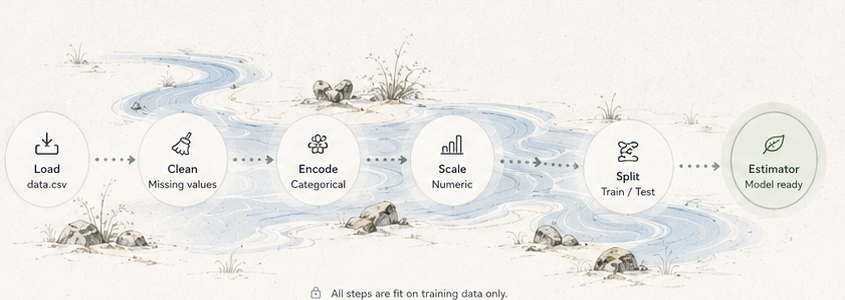
Clean, encode, scale - visualize the flow.
Rank them live on Iris, honestly.
| Model | Accuracy | Macro F1 | Time |
|---|---|---|---|
 Logistic Regression Logistic Regression | - | ||
| Random Forest | - | ||
| Gradient Boosting | - | ||
| SVM (RBF) | - | ||
| KNN | - |
Ship your model with confidence.
Why not just scikit-learn?
BreezeML chooses the task, preprocessing, split, metrics, and cross-validation defaults so the first model is honest.
compare(), explain_decisions=True, audit(), fairness, drift, and cards make each result easier to inspect.
export() writes a standalone scikit-learn script, so the trained workflow can leave BreezeML behind.


